Typical example
Whisper
A whisper is quiet at close range. Distance and room reflections can change the reading substantially.
Usually well below occupational exposure limits.
25–30 dBRead sound guide
Explore typical ranges, compare examples and open a sourced guide where one is published. These are context-dependent reference ranges, not fixed readings.
A whisper is quiet at close range. Distance and room reflections can change the reading substantially.
Usually well below occupational exposure limits.
A whisper is quiet at close range. Distance and room reflections can change the reading substantially.
Usually well below occupational exposure limits.
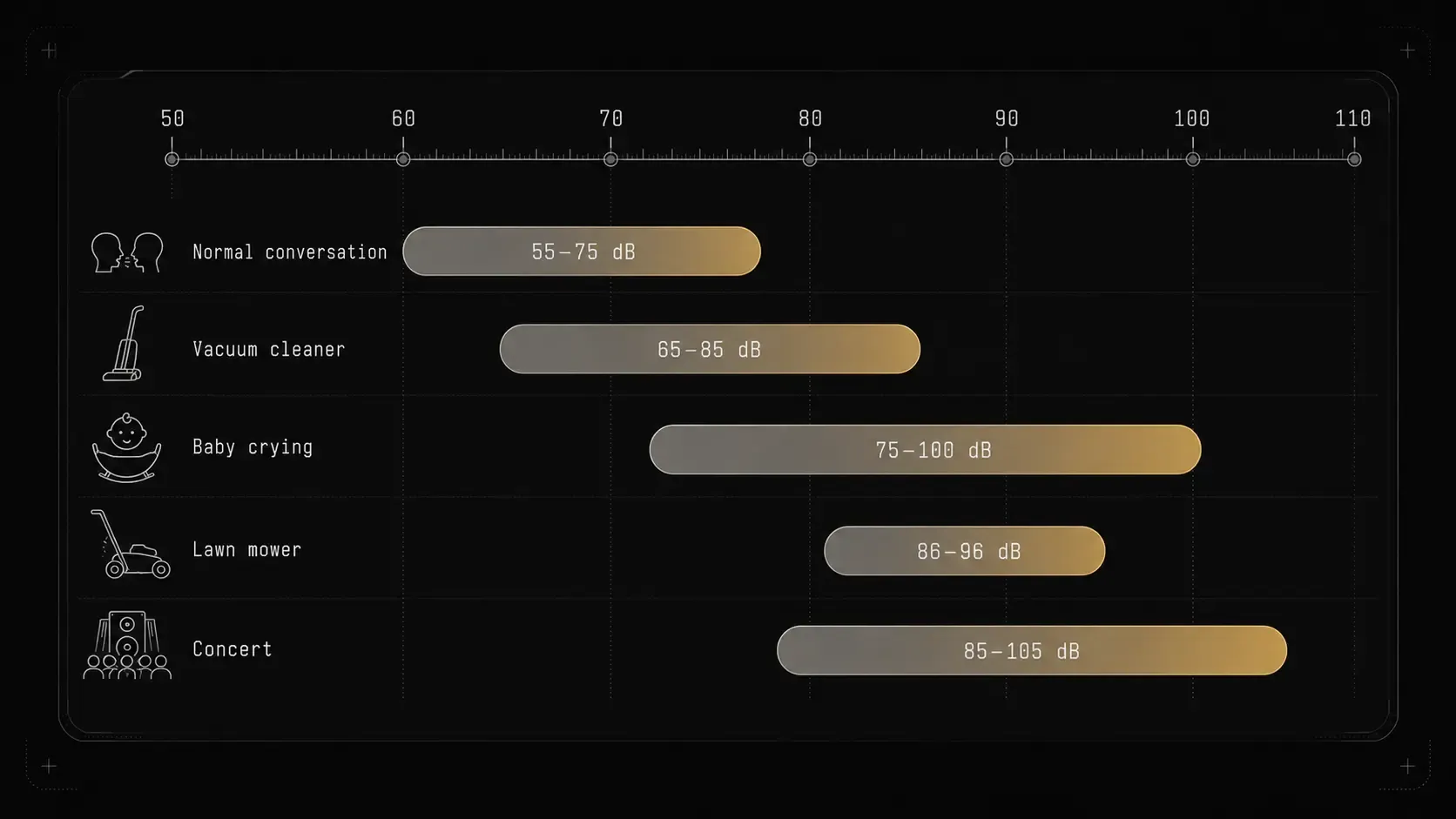
Normal conversation varies with vocal effort, distance, background noise and room acoustics.
Ordinary one-to-one conversation is generally not treated as a hearing hazard.
Read sound guideVacuum cleaner readings change with the model, setting, floor, room and microphone position.
Duration matters more for repeated or occupational cleaning than for a short household task.
Read sound guideRoad traffic changes with vehicle mix, speed, distance and surrounding buildings.
Long or repeated exposure near the upper end deserves attention.
Powered mower levels vary with the machine, blade, load, terrain and operator position.
Levels in this range can accumulate occupational noise dose quickly.
Read sound guideConcert levels vary by audience position, loudspeaker layout, venue, programme and averaging period.
At higher average levels, a full occupational reference dose can accumulate rapidly.
Read sound guideCrying levels vary strongly with age, vocal effort, distance, room and whether average or maximum is reported.
A close loud cry and repeated exposure are different contexts; the reading cannot assess health.
Read sound guideSirens are designed to remain audible over other sound and can be intense at close range.
Move away from the source when practical; distance strongly affects the level.
Fireworks create brief impulse peaks, but this reference range is an A-weighted Fast reading from one display; true peaks can be higher.
Impulse sound is not well represented by a simple continuous-exposure estimate.
Typical ranges vary with distance, environment, source and measurement method.
These approximate ranges depend on distance, metric and measurement conditions.
Whisper: 25–30 dBA. Active-source averages compiled from measurements at 1.5–5 metres.
Source: Effects of noise from oil and gas development on raptors and songbirds—A science synthesis to inform National Environmental Policy Act analyses — Logan M. Maxwell et al., U.S. Geological Survey, 2024-10-29; revised 2025-12-22.
Busy traffic: 73–83 dBA. Daytime average levels at four Bangkok roadside traffic zones; source values are rounded to whole decibels.
Source: Monitoring and Assessment of Daily Exposure of Roadside Workers to Traffic Noise Levels in an Asian City: A Case Study of Bangkok Streets — Shing Tet Leong and Preecha Laortanakul, Environmental Monitoring and Assessment, 2003-06.
Siren: 110–129 dBA. Average educational rating for emergency-vehicle sirens; the source does not report distance or averaging time.
Source: Hearing Protectors — National Institute on Deafness and Other Communication Disorders, National Institutes of Health, 2020-11; revised 2025-04-16.
Fireworks: 100–115 dBA. A-weighted Fast (125 ms) measurement about 100 metres from one nighttime aerial display; not a true impulse-peak range.
Source: Noise and low-frequency sound levels due to aerial fireworks and prediction of the occupational exposure of pyrotechnicians to noise — Tagayasu Tanaka, Ryoichi Inaba and Atsuhito Aoyama, Journal of Occupational Health, 2016-11-20.
Sounds without a full article remain available in the Explorer without linking to unfinished pages.