Why Does 85 dB Matter?
Why 85 dBA appears in hearing-risk guidance, what NIOSH means by 85 dBA for eight hours, and why it is not a universal safety threshold.
The number 85 matters because NIOSH uses 85 dBA as the criterion level for its recommended occupational exposure limit. A constant 85 dBA exposure for eight hours equals 100% of the NIOSH daily noise dose. It is not an instantaneous damage threshold, and it does not guarantee zero risk for everyone who stays below it. NIOSH
The more precise notation is 85 dBA because the recommendation uses A-weighted sound. The A-weighting filter changes how different frequencies contribute to the reported level.
dB vs dBA: What Is the Difference?
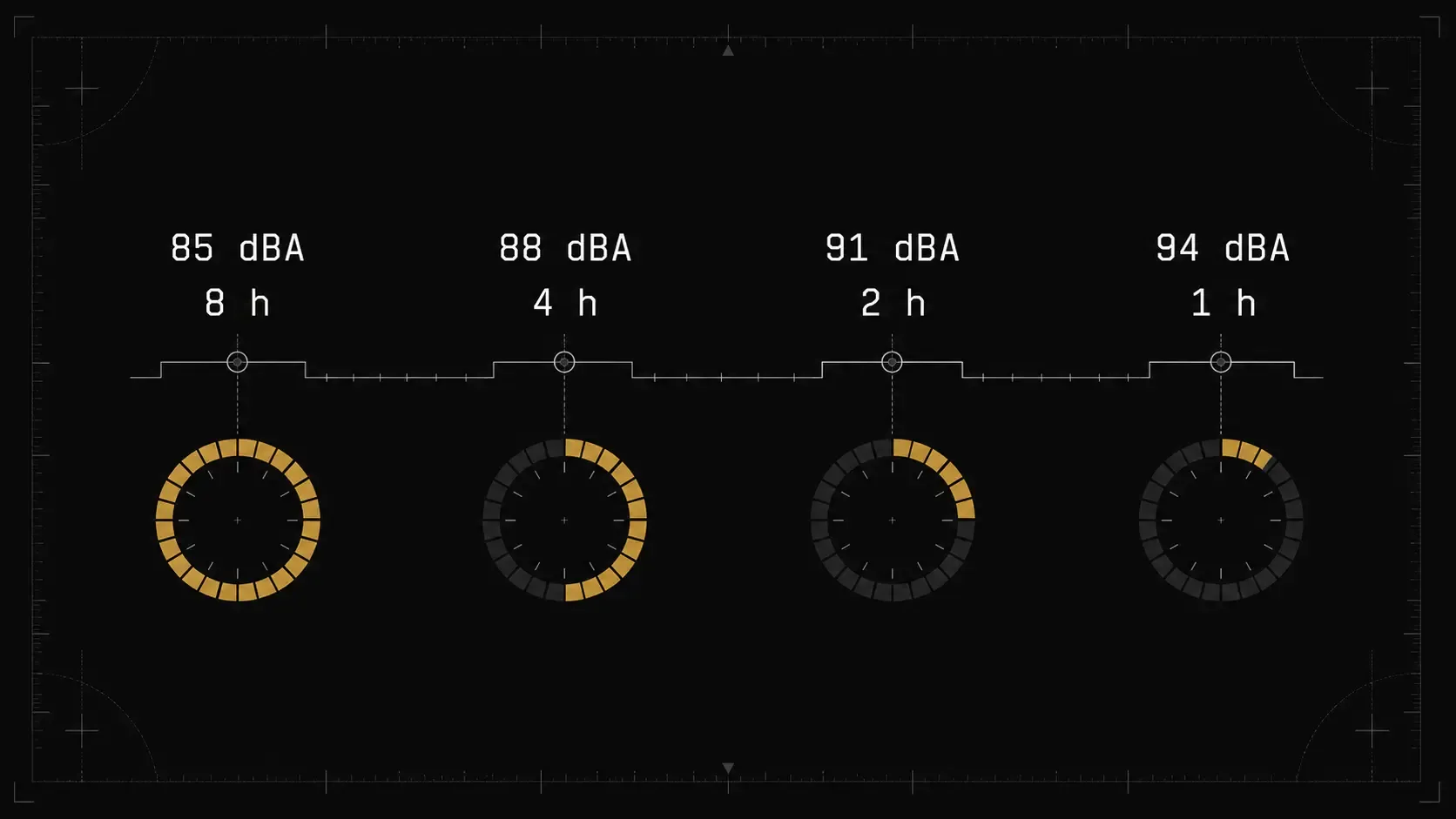
What 85 dBA means in the NIOSH recommendation
NIOSH recommends limiting occupational noise exposure to an eight-hour time-weighted average of 85 dBA. The recommendation is commonly called the NIOSH REL, or recommended exposure limit. NIOSH
Each part of that statement matters:
- 85 dBA identifies the A-weighted criterion level.
- Eight hours identifies the work-shift reference period.
- Time-weighted average means louder and quieter periods can be combined across the shift.
- Recommended exposure limit means a health-based recommendation, not a universal biological boundary or a law that applies everywhere.
Eight hours at a constant 85 dBA uses the full NIOSH daily reference dose. A shorter period uses part of that dose. A louder period uses it more quickly.
The criterion was developed to reduce the risk of material hearing impairment over a working lifetime. NIOSH has estimated that a lifetime of occupational exposure at 85 dBA still carries residual excess risk. The recommendation reduces risk but does not eliminate it. NIOSH risk
Why the reference period is eight hours
The eight-hour period reflects a conventional occupational shift. NIOSH expresses exposure through an eight-hour TWA so that a changing workday can be reduced to an equivalent average.
A worker does not have to experience exactly 85 dBA for eight continuous hours to reach the limit. A day can include several periods at different levels. Each period contributes a fraction of the daily dose, and the fractions are added.
For example, two hours at 88 dBA uses half of the NIOSH daily allowance because the full reference duration at 88 dBA is four hours. One hour at 91 dBA uses the other half because the full duration at 91 dBA is two hours. The combined dose reaches 100%. NIOSH limits
The eight-hour TWA is therefore a method for combining exposure, not a countdown that starts whenever a meter reaches 85 dBA.
The 3 dB exchange rate explains the time relationship
NIOSH uses a 3 dB exchange rate. Every 3 dB increase approximately doubles sound energy, so the time needed to reach the same reference dose is halved.
| Average level | Time to 100% NIOSH daily dose |
|---|---|
| 85 dBA | 8 hours |
| 88 dBA | 4 hours |
| 91 dBA | 2 hours |
| 94 dBA | 1 hour |
| 97 dBA | 30 minutes |
| 100 dBA | 15 minutes |
Source: NIOSH limits.
This relationship is why a small numerical increase can have a large effect on recommended exposure time. An increase from 85 to 91 dBA is only 6 dB on the meter, but it reduces the NIOSH reference duration from eight hours to two hours.
The 3 dB rule is an energy-based dose model. It should not be treated as proof that every sound with the same calculated energy creates exactly the same biological effect. Spectrum, impulsiveness, repetition, previous exposure, and individual susceptibility can matter.
Is 3 dB Twice as Loud? Sound Energy vs Perceived Loudness
Why 85 dBA is not a magic threshold
Hearing risk does not switch on at 85 dBA. Long or repeated exposure below 85 dBA may still contribute to risk, especially across long time periods. A short exposure above 85 dBA does not prove that injury occurred.
Several facts prevent 85 dBA from serving as a universal safe or dangerous line:
- NIDCD states that sounds at or below about 70 dBA are generally unlikely to cause noise-induced hearing loss even after long exposure, while long or repeated exposure at or above 85 dBA can cause hearing loss. These are broad public-health statements, not exact individual boundaries. NIDCD
- WHO uses 80 dB for 40 hours per week as its adult recreational listening allowance, rather than the NIOSH work-shift model. WHO
- The European Union begins occupational action at a daily or weekly exposure of 80 dBA, with an upper action value at 85 dBA. EU
- People exposed to the same sound may have different outcomes because susceptibility varies. NIOSH hearing loss
The safest public explanation is that 85 dBA is an important occupational reference point. It signals that exposure time and accumulated dose need attention. It does not prove safety below the number or injury above it.
The same 85 dBA does not mean the same thing in every framework
NIOSH is not the only organization that uses 85 dBA.
OSHA uses 85 dBA as the eight-hour action level for a hearing conservation program in covered United States workplaces. Under OSHA’s dose calculation, that action level corresponds to 50% dose. OSHA’s permissible exposure limit is 90 dBA for eight hours, using a 5 dB exchange rate. OSHA
NIOSH uses 85 dBA for eight hours as 100% dose and applies a 3 dB exchange rate. The same exposure can therefore produce a different percentage under the two systems.
The EU framework uses 85 dBA as its upper exposure action value. That value is tied to specific employer duties under European occupational law. It is not simply another name for the NIOSH REL.
WHO’s recreational examples also include 85 dB, but under a weekly framework. WHO lists 12 hours and 30 minutes per week at 85 dB for adults. That value should not be substituted for an occupational limit or described as a personal guarantee. WHO
The number must always be accompanied by the organization, weighting, time basis, and purpose.
NIOSH vs OSHA Noise Exposure Limits
Impulse noise needs more than an eight-hour average
A gunshot, explosion, firework, or metal impact can be very brief while producing an extreme peak. An eight-hour A-weighted average may remain modest even though the peak itself is hazardous.
NIOSH and OSHA guidance uses a 140 dB peak ceiling for impulse or impact noise. That ceiling is not a harmlessness boundary. A lower peak can still present risk depending on the pressure, duration, repetition, spectrum, distance, and protection. OSHA manual
Peak assessment also requires suitable equipment. Phone microphones may compress or clip before a very high peak reaches the app. A displayed phone peak should not be used to prove that an impulse stayed below an occupational limit.
How 85 dBA should be explained to consumers
A clear explanation separates the reference model from the person’s actual medical outcome:
Under NIOSH occupational guidance, 85 dBA averaged over eight hours equals 100% of the recommended daily noise dose. Each 3 dB increase halves the reference time. This is a population-level exposure guideline, not a guarantee that the exposure is harmless for every person.
The following statements should be avoided:
- “Anything below 85 dB is safe.”
- “Hearing damage begins after exactly eight hours.”
- “A brief reading above 85 dB means damage occurred.”
- “OSHA permits a higher level, so its limit is safer.”
A useful reading also needs the correct metric. NIOSH’s criterion refers to an A-weighted average, not an isolated maximum, peak, or unlabeled live number.
Use the reference without treating it as a promise
The value 85 dBA is useful because it connects level, time, and accumulated occupational dose. It gives employers, workers, researchers, and measurement tools a consistent point of reference.
Its value is lost when it is reduced to a universal threshold. The meaningful statement includes the framework: 85 dBA as an eight-hour NIOSH recommended occupational average, using a 3 dB exchange rate.
Check the active standard in dBcheck
Use dBcheck’s dosimeter to compare an estimated A-weighted exposure with a named standard. The display should identify NIOSH or OSHA because the same sound history can produce different dose values under each system. Treat the result as an exposure estimate, not as proof that a particular period is safe for you.
NIOSH Exposure Time at 85 dBA: How the Model Works Safe Exposure Time Calculator
Sources
- CDC/NIOSH, Understand Noise Exposure. https://www.cdc.gov/niosh/noise/prevent/understand.html
- CDC/NIOSH, Health Hazard Evaluation Report 2007-0225-3386. https://www.cdc.gov/niosh/hhe/reports/pdfs/2007-0225-3386.pdf
- CDC/NIOSH, Understanding Noise Exposure Limits: Occupational vs. General Environmental Noise. https://www.cdc.gov/niosh/bulletin/2016/noise.html
- NIDCD, Noise-Induced Hearing Loss. https://www.nidcd.nih.gov/health/noise-induced-hearing-loss
- World Health Organization, Deafness and hearing loss: Safe listening. https://www.who.int/news-room/questions-and-answers/item/deafness-and-hearing-loss-safe-listening
- European Union, Health and safety at work: exposure to noise. https://eur-lex.europa.eu/EN/legal-content/summary/health-and-safety-at-work-exposure-to-noise.html
- CDC/NIOSH, Noise-Induced Hearing Loss. https://www.cdc.gov/niosh/noise/about/noise.html
- OSHA, 29 CFR 1910.95, Occupational Noise Exposure. https://www.osha.gov/laws-regs/regulations/standardnumber/1910/1910.95
- OSHA Technical Manual, Section III, Chapter 5. https://www.osha.gov/otm/section-3-health-hazards/chapter-5