Phone Sound Meter vs Professional Meter
Compare phone sound meter apps with professional meters for accuracy, calibration, peak capture, compliance, cost, and practical use.
A phone sound meter is suitable for awareness, preliminary screening, and controlled comparisons where a few decibels of uncertainty will not cause harm. A professional sound level meter is the appropriate choice when the measurement must be traceable, follow a standard, capture difficult peaks or frequency content, establish compliance, support engineering work, or withstand technical or legal scrutiny. NIOSH OSHA
The difference is not simply that one device is cheap and the other is accurate. Performance depends on the complete measurement system, calibration, settings, procedure, environment, and maintenance.
Are Decibel Meter Apps Accurate?
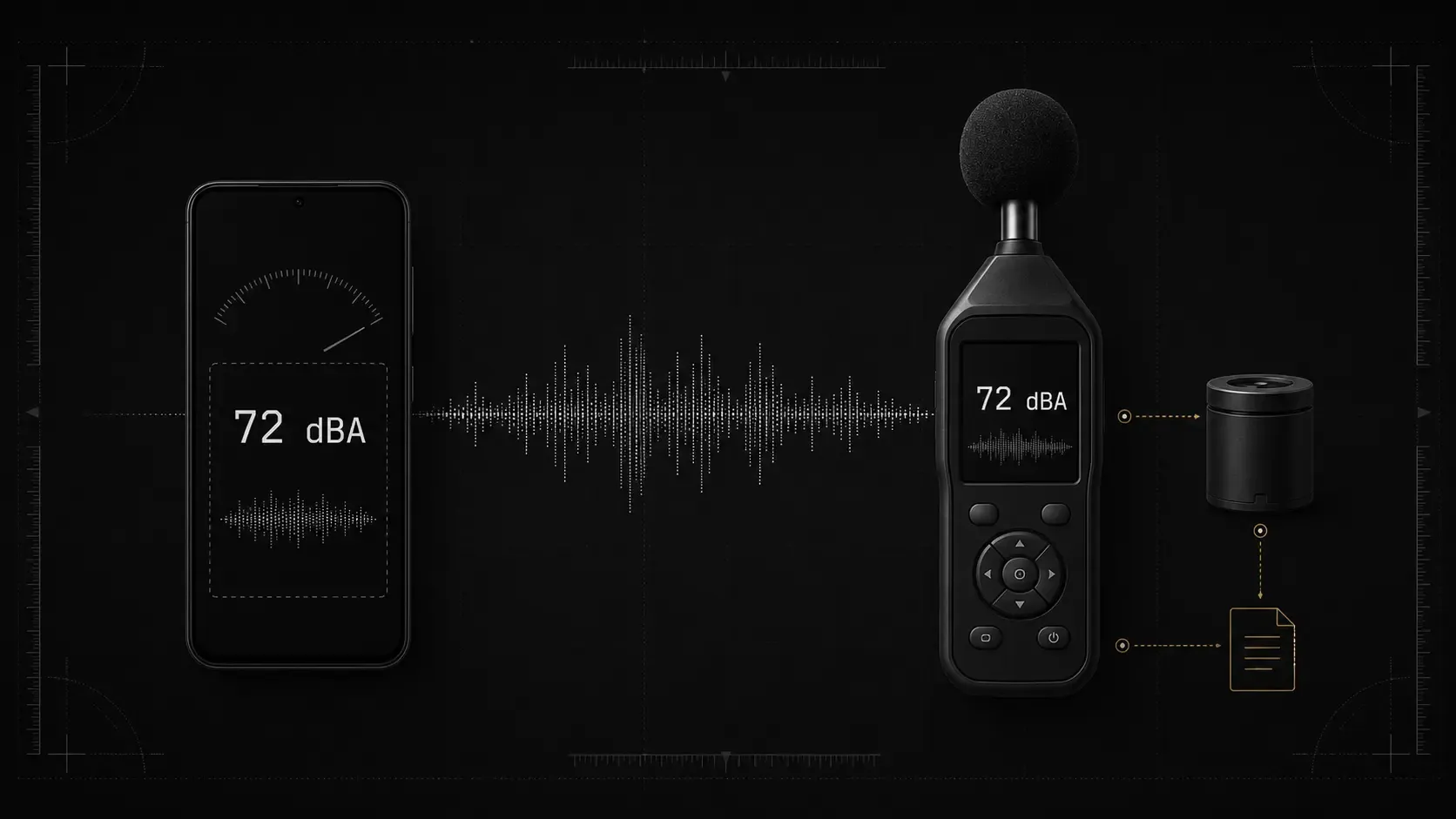
The main differences at a glance
| Area | Phone sound meter app | Professional sound level meter |
|---|---|---|
| Primary use | Awareness, screening, education, relative comparison | Standards-based, occupational, environmental, engineering, research, and official measurement |
| Microphone | Consumer microphone designed mainly for speech and media | Measurement microphone with specified acoustic performance |
| Calibration | Often a user offset or device profile | Field checks with an acoustic calibrator and traceable laboratory calibration |
| Device variation | Can vary substantially by phone model and audio path | Model performance is specified, but individual instruments still need calibration and checks |
| Weighting and response | Depends on app implementation and phone processing | Defined functions tested as part of the complete instrument |
| High levels and peaks | Compression, clipping, smoothing, or missed peaks may occur | Wider specified range and standardized peak or time-weighted response where supported |
| Official use | Usually unsuitable as the sole official measurement | May be accepted when the required class, method, calibration, and reporting rules are followed |
| Cost and access | Low cost and always available | Higher purchase, rental, calibration, and training cost |
The table describes typical roles. A selected calibrated phone system can perform well, while an incorrectly used professional meter can produce a bad result. Kardous and Shaw
Microphone quality and measurement range
A smartphone microphone is built into a device designed for calls, video, voice assistants, and media capture. Its sensitivity, frequency response, noise floor, overload point, and directionality may not be published for sound level measurement.
The microphone is also only one part of the phone input chain. Analog gain, converters, firmware, noise suppression, beamforming, automatic gain control, and app-selected audio sources can affect the signal.
A professional sound level meter uses a measurement microphone and electronics designed for defined acoustic performance. The instrument documentation normally specifies its frequency range, level range, detector functions, environmental limits, and overload behavior.
That does not mean every professional meter can measure every sound. A meter can still be used outside its range, overloaded, incorrectly configured, damaged, or paired with the wrong microphone. The task and governing method determine what range and functions are needed.
Calibration and traceability
Phone calibration is often a stored offset. It may improve agreement with a reference near the calibration level, but it does not validate the full system.
A professional workflow commonly includes a field calibration check before and after the measurement with an acoustic calibrator. The instrument and calibrator also need periodic laboratory calibration that can be traced through an appropriate calibration chain. NIOSH guide OSHA
Traceability matters when another person must be able to evaluate how the result relates to recognized reference standards. A screenshot from an app rarely includes enough information to establish that chain.
Calibration is not permanent. A professional meter that has not been maintained or checked should not be assumed accurate merely because it has a Class 1 or Class 2 label.
How to Calibrate a Decibel Meter App
Frequency weighting
Both phone apps and professional meters may offer A, C, or Z frequency weighting.
The label alone does not prove that the filter is implemented correctly. In a professional instrument, weighting performance is part of the complete system requirements and tests. In a phone app, the calculation may be correct in software while the microphone and audio path still alter the spectrum before the filter is applied.
A-weighting is widely used for environmental and occupational noise. C-weighting retains more low-frequency content and is used for some high-level and peak measurements. Z-weighting provides a nominally flat standardized response within the instrument’s specified range.
dB vs dBA: What Is the Difference? A phone with weak low-frequency response cannot recover missing low-frequency information merely by selecting C or Z weighting.
Response time, average, maximum, and peak
Professional sound level meters distinguish functions such as time-weighted Fast and Slow levels, equivalent continuous levels, maximum values, and peak sound pressure.
Phone apps may provide similar labels, but their implementation and hardware limits vary. Some apps use custom smoothing windows rather than standardized time responses. The display refresh rate may also be confused with the detector response.
Average levels are generally easier for a phone to estimate than very short maxima or peaks. Lee and Hampton found that calibrated phone systems could agree reasonably for average levels while producing larger errors for maximum values. Lee and Hampton
A phone microphone may compress or clip a short event before the app calculates a peak. The app cannot reconstruct pressure information that the capture path failed to preserve.
For fireworks, blasts, impacts, weapons, or other strong impulses, use equipment and procedures intended for peak measurement. A displayed phone peak should not be treated as proof that the true peak stayed below a limit.
High-level clipping and compression
There is no universal sound level at which all phones fail. Some systems remain reasonably linear at levels where others already compress.
Digital clipping can produce flat-topped samples near full scale. Analog microphone or preamplifier saturation may happen before digital full scale. Automatic gain control can also lower gain and understate the increase without producing obvious clipping.
Professional meters specify level ranges and overload indicators. A compliant measurement still requires the operator to select the correct range and respond to overload warnings.
A phone app may show values up to 120 or 130 dB because its user interface allows those numbers. The display range is not evidence that the complete phone can measure them accurately.
Variation between devices
Android phone measurements can vary materially across models because manufacturers use different microphone arrays, components, firmware, and processing. NIOSH cites this fragmentation as a reason it cannot verify one Android app across the market. NIOSH
Professional instruments also differ. Class 1 and Class 2 identify performance categories, not identical products. Instruments may have different features, ranges, microphone types, logging options, and environmental capabilities.
The important distinction is that a professional system intended for standards-based work has documented specifications and can be tested as a complete system. An arbitrary phone and app usually lack that evidence.
What Class 1 and Class 2 mean
IEC 61672 defines performance requirements for sound level meters. Class 1 generally has tighter tolerances and is used where lower measurement uncertainty or a specified Class 1 method is required. Class 2 is commonly used for general field and occupational measurements where the governing method allows it. IEC 61672
OSHA describes Type 1 instruments as precision field instruments and Type 2 instruments as general-purpose instruments. Its technical manual uses simplified figures of approximately plus or minus 1 dBA for Type 1 and plus or minus 2 dBA for Type 2 in that compliance context. Those figures are not complete uncertainty statements for every level, frequency, temperature, orientation, and measurement condition. OSHA
Instrument class applies to the complete system. A Class 2 microphone connected to an unknown phone and app does not automatically create a Class 2 sound level meter.
Celestina and colleagues found that one specific phone, app, and external microphone combination met most of the periodic Class 2 requirements they tested. The study demonstrates that a carefully designed smartphone system can approach professional performance. It does not classify other phones or app combinations. Celestina et al.
Documentation and official use
A professional report may need to record:
- instrument and microphone model and serial number
- instrument class
- calibration certificate details
- pre-measurement and post-measurement calibrator checks
- frequency weighting and detector function
- date, duration, position, distance, and height
- weather and windscreen details
- source operating condition
- uncertainty and applicable standard
- raw or logged data needed for review
A phone app can record some of this context, but it usually cannot establish the instrument class and traceability required by an official procedure.
OSHA states that smartphone apps may provide rough estimates but may not document OSHA compliance. Other jurisdictions use their own rules and standards. The relevant authority or method determines what evidence is acceptable. OSHA
A phone screenshot may still help show when and where a concern occurred. It can support a request for an inspection without being the official measurement itself.
Cost and convenience
The phone’s strongest advantage is availability. It is already in the user’s pocket, starts quickly, and can store notes, charts, location, and time information. This makes it useful for recognizing patterns and deciding whether further investigation is justified.
A professional meter costs more to buy or rent. Calibration, accessories, windscreens, tripods, data software, and trained measurement time add expense. That cost supports a defined measurement chain and a result suitable for higher-consequence decisions.
Buying a low-cost handheld device does not necessarily solve the problem. A meter without documented performance, calibration support, suitable functions, or a trustworthy manufacturer may provide little advantage over a phone.
When a phone is sufficient
A phone app is usually sufficient for:
- comparing the same appliance before and after maintenance
- identifying which part of a route is louder
- educational demonstrations
- tracking broad trends on one known device
- screening whether a workplace or venue may need professional assessment
- documenting context for a personal or community concern
- comparing room positions with the same setup
Keep the phone, app, input, position, distance, weighting, duration, and calibration state consistent. Small differences should not be overinterpreted.
How to Measure Decibels With an Android Phone
When a professional meter or specialist is needed
Use an appropriate calibrated professional system when the result will:
- establish occupational exposure or regulatory compliance
- support environmental noise enforcement
- guide engineering controls or product certification
- determine performance near a strict threshold
- measure strong impulses, peaks, tonal sound, or difficult low-frequency noise
- form part of research requiring traceable SPL data
- be submitted in litigation or a contested technical process
- affect a safety-critical decision
A qualified acoustician, occupational hygienist, or other relevant professional may also be needed because the measurement method can matter as much as the meter.
Choose the tool according to the consequence of error
The phone is valuable because it makes sound measurement accessible. The professional meter is valuable because its performance, calibration, and use can be documented within a recognized method.
Use dBcheck for estimated measurements, session comparisons, and observing MIN, AVG, MAX, Peak, and equivalent level information where available. Use a calibrated professional meter and the applicable procedure when the number must prove compliance, support an official finding, or carry significant safety, engineering, or legal consequences.
Sources
- CDC/NIOSH, NIOSH Sound Level Meter App. https://www.cdc.gov/niosh/noise/about/app.html
- CDC/NIOSH, NIOSH Sound Level Meter Application: Features and Instructions. https://www.cdc.gov/niosh/media/pdfs/NIOSH-Sound-Level-Meter-Application-app-English.pdf
- OSHA Technical Manual, Section III, Chapter 5. https://www.osha.gov/otm/section-3-health-hazards/chapter-5
- IEC 61672-1:2013, official publication page. https://webstore.iec.ch/en/publication/5708
- Kardous and Shaw, Evaluation of smartphone sound measurement applications using external microphones: A follow-up study. https://europepmc.org/article/MED/27794313
- Celestina, Hrovat, and Kardous, Smartphone-based sound level measurement apps: Evaluation of compliance with international sound level meter standards. https://doi.org/10.1016/j.apacoust.2018.04.011
- Lee and Hampton, Smartphone applications for measuring noise in the intensive care unit: A feasibility study. https://doi.org/10.1016/j.jcrc.2023.154435